Did You Know ?
Did You Know … The connection between the Statue of Liberty and Freemasonry?
New York’s Statue of Liberty is one of the most universal symbols of Freedom and Democracy. It is located on the 12-acre Liberty Island in New York Harbour and is known all over the world, especially to the thousands of immigrants who approached New York by ship. It was often their first sight as they arrived to begin a new life at the nearby Ellis Island.
The Statue of Liberty or Liberty Enlightening the World, was also known as “The Statue of Liberty and Freemasonry” to the band of French Freemasons who conceived the idea of the monument. It was in 1870 that French law professor, politician and noted member of the Grand Orient (Grand Lodge of France) Bro. Edouard Rene de Laboulaye, who admired America’s success in establishing a democratic government and the close history between France and the USA. Laboulaye approached his friend and fellow Freemason, Bro. Fredderic Auguste Bartholdi about designing a lasting monument to independence and human liberty. Bro. Bartholdi was a noted artist and sculptor and member of Lodge Alsace-Lorraine in Paris.
In late 1870, Bartholdi was despatched to America to solicit support for the statue, find a suitable site and to work on the concept designs. The original plan was to have the monument ready for the 4th July 1876, the date of America’s Centennial. As Bartholdi was entering New York Bay, he had the vision of a magnificent Goddess holding aloft a torch in her hand and welcoming all visitors to the land of freedom and opportunity. He quickly committed his ideas to paper and sketched the colossal neoclassical statue much as it is today. He was influenced by the image of the Roman Goddess – Libertas, Sol Invictus (Unconquered Sun).
There was a great delay in raising the required funds for the project. By 1874 Batholdi had returned to France with 4 years wasted with no work started on the construction.
In 1875 Bro. Laboulaye proposed that the French would finance the statue and the US would provide the site and the pedestal. By this stage Bro. Bartholdi had completed the design and had given up on completion in time for the American 100th anniversary.
Bartholdi began work on the statue assisted by over 50 craftsmen working seven days per week, day and night in shifts. The Craftsmen were experts in the art of Repousse, a technique for creating sculptural forms by hammering sheet metal inside moulds. Copper sheets were used to form the outer skin of the statue. The intricate skeleton for the statue was designed by Alexander Gustave Eiffel, it is claimed in many sources that Eiffel was a Mason, however there is no record of his membership. Eiffel was well known for his iron bridges, but most famous for the Eiffel Tower erected in 1889. The massive statue was erected in sections at Eiffel’s ironworks in Paris before shipment.
The 4th July 1876 target date past without any tangible progress on site and Bro. Bartholdi set himself the new goal of having the statues head complete for the opening of the Paris World Fair, 1st May 1878. Unfortunately, the lady was late again, and the head was not complete until late June 1878. Fundraising for the project in France proved difficult and this considerably slowed the progress.
Progress on the pedestal proved equally challenging technically and financially. The design responsibility was given to Bro. Richard M Hunt, a remarkable architect and Freemason, who produced the designs for some of the most well-known buildings in New York. Plagued by inadequate financial support, it took the intervention of Joseph Pulitzer, the famous newspaper owner, to kick start the fundraising. Pulitzer came up with the idea to publish the name of every contributor, regardless of the size of the donation in his newspaper. This was a remarkable success particularly from schoolchildren who donated as little as a few cents to get their name in the paper. Circulation of the newspaper dramatically increased as a result of Pulitzer’s initiative.
The pedestal was an impressive civil engineering project in its own right. The base took the shape of an 11-pointed star. The foundation alone needed 24,000 tons of concrete, the largest single mass at that time ever poured. The bottom of the pediment is 91sq/ft and tapers to 65ft at the top. The whole pedestal is 90ft high.
On the 5th August 1884, a formal Masonic cornerstone ceremony was conducted by MWor. Bro. William Brodie Grand Master of the Grand Lodge of New York. It was a very wet day attended by over 100 masons and dignitaries from the US and France. Bro. Richard Hunt presented the working tools to the Grand Master, who in turn distributed them to the Grand Lodge Officers. The cornerstone was then tested, and being found Square, Level and Plumb; the Deputy Grand Master completed the work by applying the mortar and having the stone lowered into place. The Grand Master then struck three blows with the gavel and declared the stone duly laid. A copper box was secreted within the cornerstone. Inside the box was, a copy of George Washington’s Farewell Address, 20 bronze medals of previous Presidents of the USA, copies of New York city newspapers, a portrait of Bro. Bartholdi, a copy of a poem on Liberty and a list on parchment of the officers of the Grand Lodge of New York.
The Statue was finally completed in Paris and was disassembled for shipment to New York. Every copper plate, beam and section were numbered, coded and packed. 350 sections were packed into 214 cases and a special train transported the statue to the port. A month later in June 1885 the statue arrived in New York. It took 15 months to assemble the 125 tons of internal steelwork and clad it with 80 tons of copper cladding. 300,000 rivets were used, with the final piece of copper hammered into place on the 23rd October 1886 – over 10 years late.
On the 28th October 1886 President Grover Cleveland, former New York Governor, presided over the ceremony of dedication. On the morning of the event President Cleveland headed the parade through the streets of New York. As the parade passed by the New Your Stock Exchange, traders threw ticker tape from the windows, beginning the tradition of the ticker tape parade.
No members of the public were permitted on the island during the dedication ceremonies, which were reserved entirely for dignitaries. Only two women were granted access to the ceremony, Bartholdi’s wife and the daughter of the head of the French delegation. Ironically, the embodiment of Liberty as a woman was lost on those who attended.
Freemasons everywhere can be humble in the knowledge of the part our fraternity played in the creation and erection of this remarkable and iconic structure. It reminds us of our obligations to spread the light of Freedom, Truth, Tolerance and Justice.
“We will not forget that Liberty has made this her home, nor shall her chosen alter be neglected” President Cleveland 28/10/1886


- Libertas, Sol Invictus – influenced the Statue of Liberty
- Richard Hunt’s Pedestal under construction 1885
- A Plaque celebrating the 100th anniversary of the ceremonial laying of the cornerstone in 1984
HMK February 2018
Sources :Wikipedia : The Statue of Liberty – article: Masonry and the Statue of Liberty, Robert C. Singer Dep. Grand Master GL of New York – article: The Square, magazine; The Statue of Liberty and Freemasonry, Fred Lomax
Did You Know ?
Did you know that the 714 Lodge Warrant was originally issued in 1790 ?
The Lodge Warrant No.714 was originally issued by the Grand Lodge of Ireland to the 1st Battalion 68th (Durham) Regiment of Foot (Later became the 1st Battalion, The Durham Light Infantry).
The 68th Regiment of Foot was formed in 1758 and was known as Lambton’s Regiment of Foot, named after its new Colonel, John Lambton, 1st Earl of Durham.
In 1763 the Regiment was shipped to Ireland and based in Dublin. The Regiment left Ireland in 1779 at almost full strength of 793 of all ranks, in December of that year it was brought up to full war strength of 847 and sent to Jamaica. The Regiment was shipped to Gibraltar in 1785 and remained there for nine years until 1794. It was during this period that an application was made to the Grand Lodge of Ireland to form a Lodge. On the 1st April 1790, the Grand Lodge of Ireland issued Warrant No. 714.
The Warrant was handed to Bro. J Coleman, Bro. J Fitzgerald and Bro. H.C. Sirr to form a Lodge. It is known that Bro. Sirr was an Irish Mason, he was the first Junior Warden.
By 1792 there were five other Irish Lodges working in Gibraltar (11,604,168,227 and 690).
In 1794 the Regiment was posted to the West Indies as reinforcements for the British forces there. The Regiment was dispersed to the islands of Martinique, St Lucia and Grenada where they fought runaway slaves known as Brigands, who were assisted by the French. By 1796 the Regiment had been reduced by fighting, but mainly by Yellow Fever to 61 fit men. The Regiment landed back in Ireland in 1797 and began to recruit and rebuild its numbers.
By early 1812 the Regiment was deployed to The Peninsular Wars in Lisbon, Portugal. They soon marched as part of the British Forces under the overall command of the famous Anglo-Irish General, Arthur Wellesley (later the 1st Duke of Wellington). They fought the French at the Battles of Salamanca, Vitoria, Pyrenees, Nivelle and Orthez until 1814, when Napoleon abdicated. The regiment returned to Ireland.
The Regiment went on to fight in the Crimean War, by this stage their numbers were up to 1240. They fought in the Battles of Alma, Sevastopol and Inkerman. At the Battle of Inkerman, Pte. John Byrne was the first recipient of the VC to be awarded during the Crimean Campaign.
Grand Lodge of Ireland records show returns from the Lodge up to the early 1800’s, when on 6th July 1815 the Warrant was cancelled.
A new printed form of the Warrant was prepared in May 1947 and The Scrabo Lodge No.714 was Constituted on 16th August 1947.
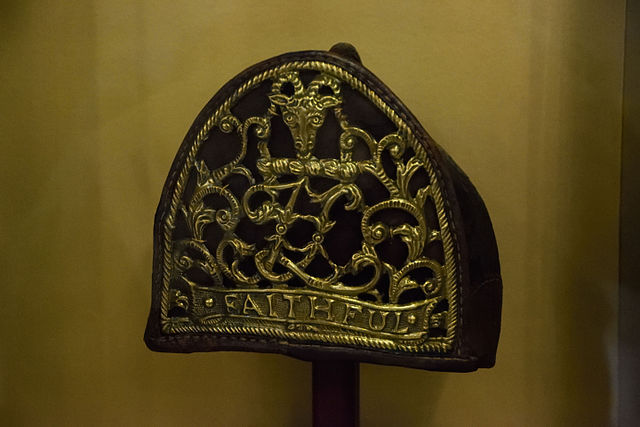
Leather cap worn by 68th Regiment of Foot in the 1770’s
HMK February 2018
Did You Know?
We were all greatly saddened at the passing of the Late WBro. Harry Thomas on the 5th August 2017. Harry was just a few weeks short of his 96th birthday and was looking forward to celebrating his 70 years in the order when he passed away.
I would imagine most people were aware of Harry’s service in the RAF during WW2, he attended his Squadron reunions in England every year.
But … did you know that Harry was held hostage by the PLO ??
Harry worked for many years as a field engineer for Shorts Missile Division. In 1969 Shorts were having some technical difficulties with a Ground to Air Missile system called Tigercat (this was the land based variant of Shorts Seacat Missile). A Team of seven engineers and technicians were in Amman in Jordan to fix the problem prior to a demonstration for King Hussein of Jordan. Unfortunately, at the time, Jordan had its own political problems with the ongoing incursions of the Palestine Liberation Organisation. Trouble was brewing with the PLO, when they decided to take over Harry’s hotel in Amman and hold the Shorts team hostage. The situation lasted a few days and thankfully no one was injured in the process. The team fixed the technical issue and proceeded to successfully demonstrate Tigercat to the King.
Harry and the team were awarded The Order of Istiqal by King Hussein for their services to the people of Jordan

Harry (center), proudly displaying his Order of Istiqal, with his colleagues from Shorts
HMK February 2018
 Scrabo Masonic Lodge 714